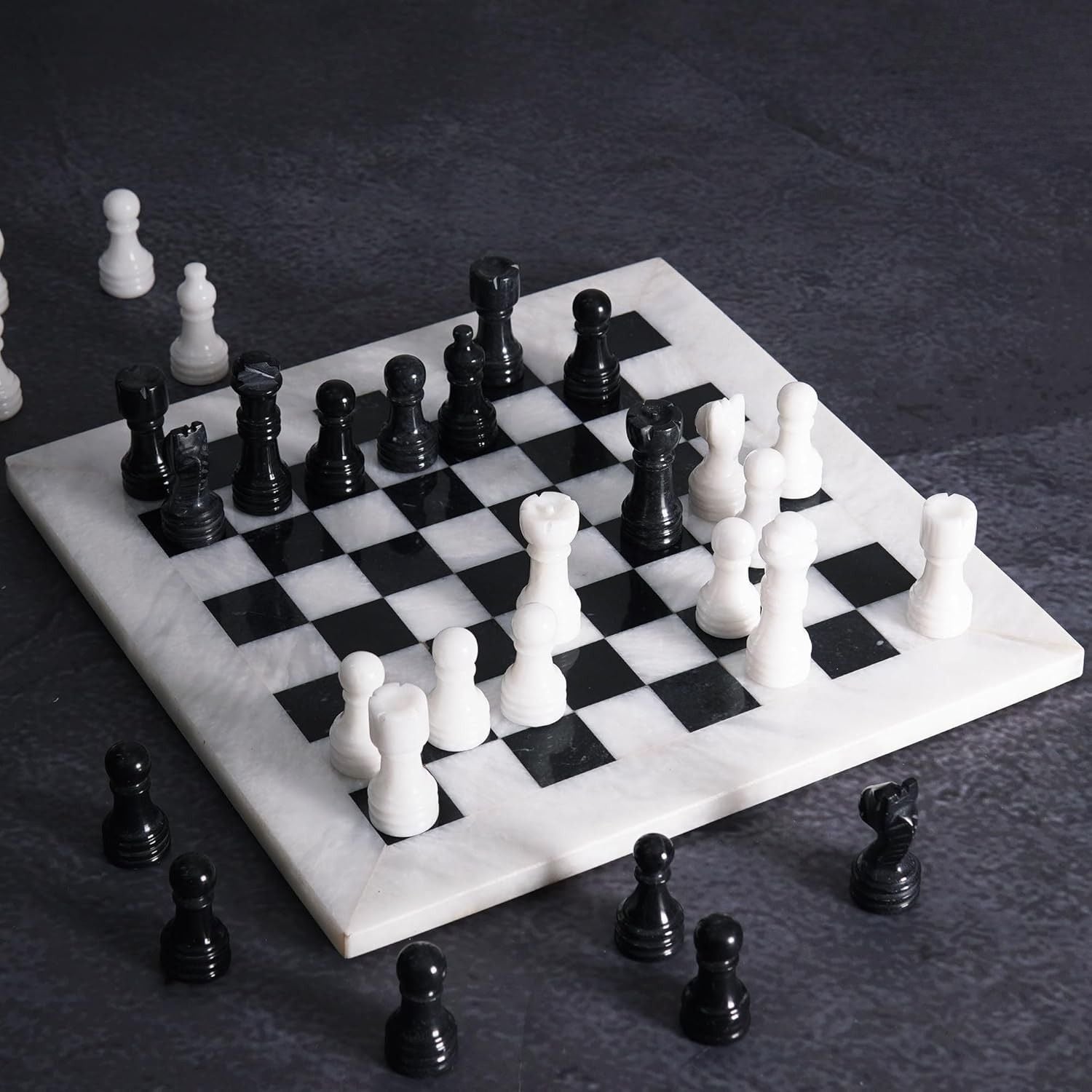
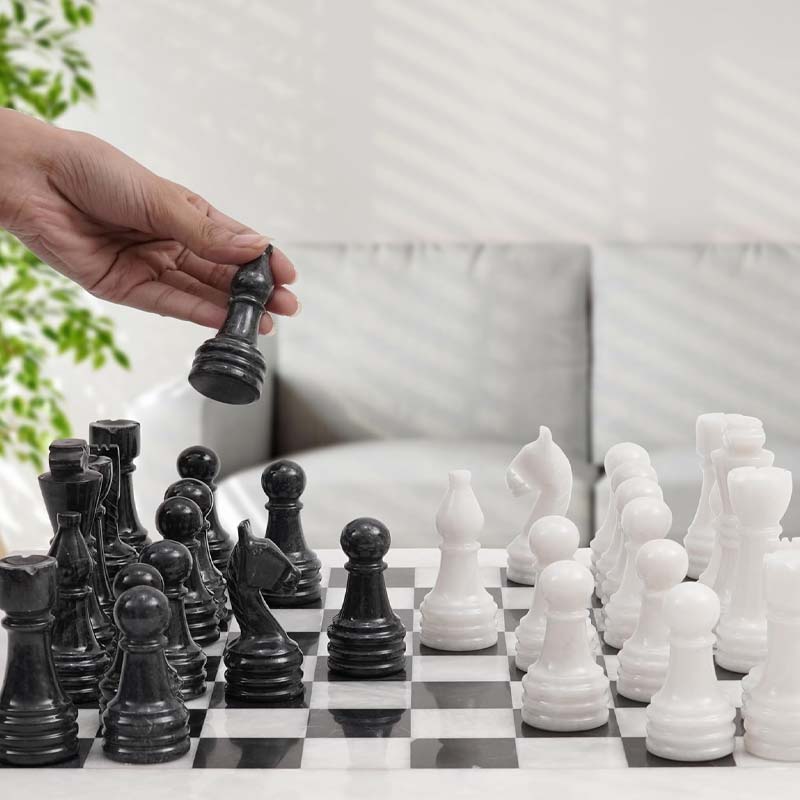
How Each Chess Pieces Moves: A Step-By-Step Guide

Chess is a two-player strategy game played on a board of 64 squares arranged in an 8×8 grid. Each player controls 16 pieces — and the goal is simple: checkmate your opponent's King. But to get there, you must first understand how each piece moves, what it can do, and how to use it effectively. Whether you are playing on a casual set or a luxury marble chess set, knowing every piece inside out is the foundation of every great chess player.
Each player starts with 16 pieces: 1 King, 1 Queen, 2 Bishops, 2 Knights, 2 Rooks, and 8 Pawns. Every piece has its own movement pattern, value, and role on the board. Understanding these is the very first step to building your strategy — just as every great board game begins with mastering the rules.
Chess Pieces and How They Move
The King

The King is the most important piece on the board. If your King is captured, the game is over. The King can move one square in any direction — horizontally, vertically, or diagonally. However, the King can never move into a square that is under attack by an enemy piece, and it is never allowed to move into check. Protecting your King at all times is the most critical principle in chess — explore our luxury marble chess sets where the King piece is carved in stunning natural stone.
The Queen

The Queen is the most powerful piece on the board. She can move in any direction — horizontally, vertically, or diagonally — across any number of squares, as long as no other piece is blocking her path. The Queen combines the power of both the Rook and the Bishop, making her the centrepiece of most attacking strategies. Losing your Queen is almost always a serious disadvantage. Browse our best-selling marble sets to see this iconic piece in hand-carved natural stone.
The Rook

The Rook — sometimes called the Castle — can move horizontally or vertically across any number of squares. It is most powerful on open files and open ranks — rows or columns with no pawns or pieces blocking its path. Rooks become especially dominant in the endgame when the board opens up. Each player has two Rooks, placed in the corners at the start of the game. The Rook's long-range control is similar to the straight-line strategy used in marble checkers.
The Bishop

The Bishop moves diagonally in any direction, any number of squares. Each player has two Bishops — one that stays on light squares and one that stays on dark squares for the entire game. Because of this, the two Bishops work together to control different areas of the board and are particularly effective at covering the centre. The Bishop is worth 3 points and is a key piece in controlling key diagonal lines. Visit our customer gallery to see the marble Bishop in action.
The Knight

The Knight is the most unique piece on the board — and the only one that can jump over other pieces. It moves in an L-shape: two squares in one direction and one square perpendicular. The Knight is worth 3 points and is particularly effective in closed positions where other pieces are blocked. Knights are often used to attack squares that other pieces cannot easily reach. In our hand-carved marble chess sets, the Knight is sculpted as a horse — one of the most beautiful pieces in the set.
The Pawn

The Pawn is the smallest piece — but never underestimate it. Pawns move forward one square at a time, with the option to advance two squares on their very first move. They capture diagonally — one square forward and to either side. Pawns cannot move backward under any circumstances. Eight pawns per side form a protective wall in front of the major pieces and play a crucial role in controlling the centre of the board. Find the perfect set for pawn practice in our gifts under $100 collection.
Pawn Promotion — The Hidden Trump Card

When a pawn reaches the opposite end of the board — crossing into enemy territory — it earns Pawn Promotion. The pawn can be exchanged for any piece except a King: a Queen, Rook, Bishop, or Knight. The best strategy is almost always to promote to a Queen, since she is the most powerful piece on the board. If multiple pawns reach the far end, each one can be promoted separately. This single rule can completely reverse a losing position — making pawns one of the most strategically important pieces in the endgame.
💡 Key rule: There can only be one King on the board at any time — but there is no limit to how many Queens you can have through pawn promotion. Promoting even one pawn to a Queen can turn the entire game around.
Chess Piece Point Values at a Glance
| Piece | Point Value | Movement |
|---|---|---|
| King | Priceless | 1 square any direction |
| Queen | 9 points | Any direction, any distance |
| Rook | 5 points | Horizontal or vertical, any distance |
| Bishop | 3 points | Diagonal only, any distance |
| Knight | 3 points | L-shape, can jump over pieces |
| Pawn | 1 point | Forward 1 square (2 on first move) |
Conclusion
Chess is a battle between two armies — and every piece in that army has a specific role, a specific value, and a specific way of moving. Master each piece and you will begin to see the board in an entirely new way. Strategy, patience, intelligence, and creativity all come together when you truly understand what every piece can do.
Ready to learn the game on a board worth playing on? Explore Royal Bishop's collection of handcrafted marble chess sets — each piece sculpted from natural stone and built to last a lifetime.
Shop Marble Chess Sets →Frequently Asked Questions
Q1: Does every chess piece move differently?
Yes — every piece has its own unique movement pattern. Although some pieces can move in similar directions, no two pieces follow exactly the same rules.
Q2: How many pieces are there on a chess board?
There are 32 pieces in total — 16 for each player. Each set includes 1 King, 1 Queen, 2 Rooks, 2 Knights, 2 Bishops, and 8 Pawns.
Q3: Can a pawn move diagonally?
A pawn moves forward one square at a time — but it captures diagonally. It can only move diagonally when capturing an enemy piece, not during a regular forward move.
Q4: Can a rook jump over other pieces?
No — the Rook cannot jump over any pieces. Only the Knight has the ability to jump over other pieces on the board.
Q5: Should you use your King to attack?
Only in the very late endgame when most other pieces have been exchanged. At all other times, keep your King protected — losing your King means losing the game.
Related Posts

Top 5 Best Opening Chess Moves

Capturing Pieces In Chess: Tips And Tricks

How to set up a chess board- Step By Step

Benefits Of Playing Chess

Pairing Marble Pieces With The Right Board Material

Marble Veining vs Structural Defects: A Guide to Stone Quality